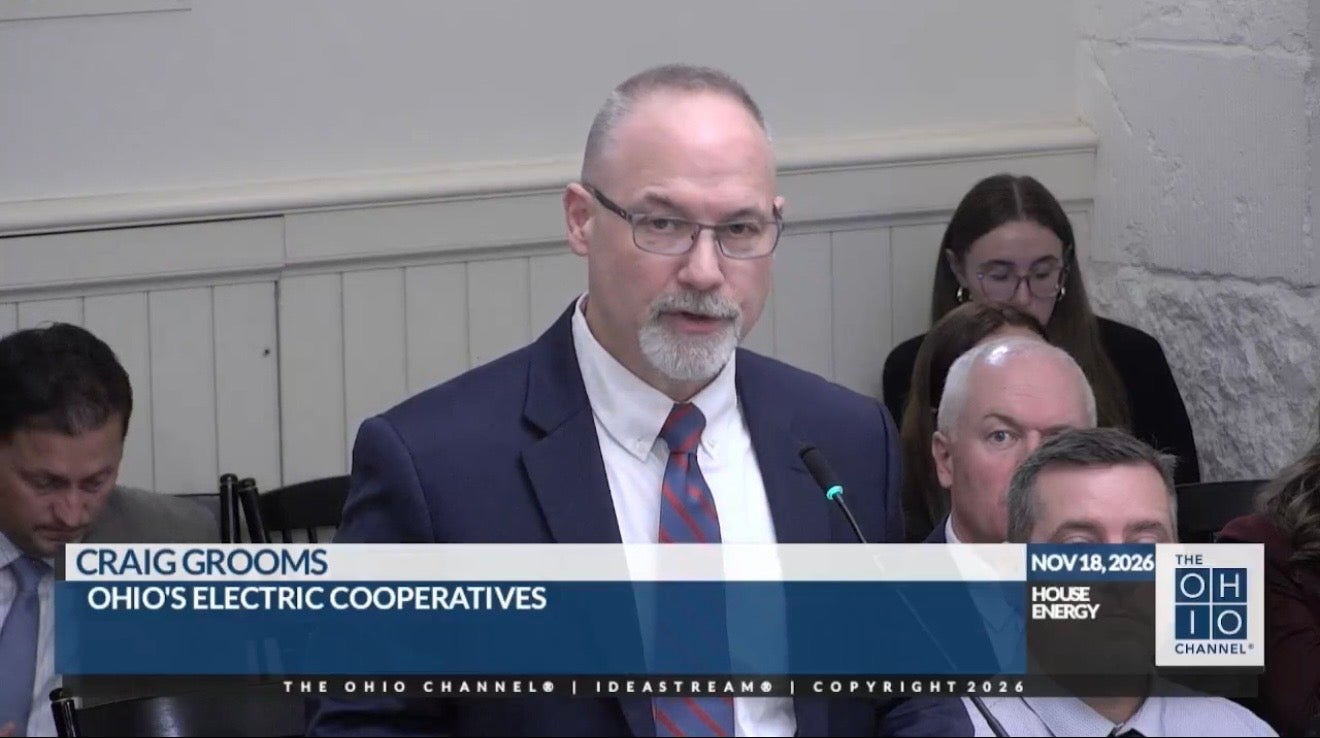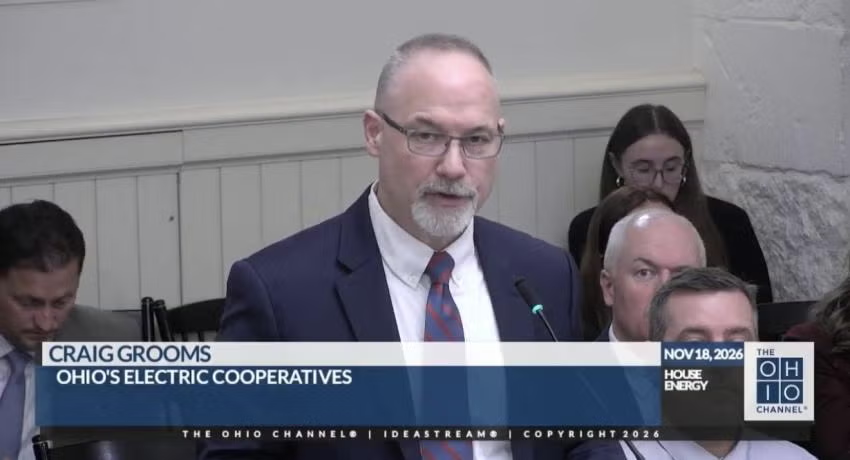
Ohio's Electric Cooperatives supports Ohio House Bill 1041, legislation that is designed to temporarily preserve electric generation resources during an ongoing energy shortage. The legislation was discussed before the Ohio House Energy Committee on November 18 and Craig Grooms, president and CEO of Buckeye Power, Inc., and Ohio Rural Electric Cooperatives, Inc. provided testimony in support of the legislation.
Ohio is facing a growing energy reliability crisis. Demand for electricity is increasing, but new power plants are not being built fast enough to replace the generation that is retiring. Grid operators have warned that this imbalance could leave Ohio and the surrounding region short of electricity needed to serve homes, businesses, hospitals, schools, and critical infrastructure. House Bill 1041 provides a temporary tool to help ensure reliable electric service by allowing needed generation resources to remain available until replacement power supplies are ready.
If House Bill 1041 is passed, it would temporarily delay the premature closure of power plants that are subject to retirement obligations under settlement agreements, when requested by grid reliability authorities and only for the duration of that reliability need. Importantly, House Bill 1041 does not invalidate existing settlement agreements, it simply postpones the retirement requirement when necessary to help keep the lights on.
Impacted by this legislation is Cardinal Unit 3, a 620-megawatt generating unit at the Cardinal Power Plant in Brilliant, on the Ohio River. Buckeye Power owns the Cardinal plant and supplies wholesale electricity to Ohio's 24 electric cooperatives, which serve approximately 1 million Ohioans. Cardinal Unit 3 is currently scheduled to retire on December 31, 2028, as required by a decade-old settlement agreement between the Sierra Club environmental group and the plant’s former operator.
Since that agreement was signed, the regional energy landscape has changed dramatically. PJM Interconnection, which operates the electric grid serving Ohio and 12 other states, and the Public Utilities Commission of Ohio's Federal Energy Advocate have formally requested that Buckeye Power continue operating Cardinal Unit 3 through the current reliability crisis as electricity demand grows faster than new power generation can be built.
“Grid operators are telling us they need this generation to maintain reliability and help control electricity costs,” Grooms said. “This legislation provides a narrow solution to a specific reliability problem. It ensures critical generation can remain available when requested by reliability authorities, while preserving the underlying settlement agreement.”
House Bill 1041 mirrors actions already taken elsewhere in the PJM region. States, including Illinois and Pennsylvania, have approved or supported similar efforts to preserve existing coal-fired resources while replacement generation is developed. These states have recognized that affordable, reliable sources of power, like Cardinal Unit 3, are needed to ensure homes and business can keep the lights on without breaking the bank. Through House Bill 1041, Ohio is doing the same.
No additional costs for Ohioans
House Bill 1041 does not provide subsidies or require funding from taxpayers or utility customers. Instead, revenues earned through competitive electricity markets should cover the costs of continued operation, maintenance, and any necessary upgrades needed to extend the life of Unit 3.
Because Buckeye Power is a nonprofit cooperative owned by the consumers it serves, it operates solely for the benefit of the approximately one million Ohioans served by Ohio's electric cooperatives, not outside shareholders. If continued operation of Cardinal Unit 3 is not economical or beneficial for cooperative members, Buckeye would have no obligation to continue operating the unit.
As a result, cooperative members and other Ohio consumers will not bear any additional costs under the legislation.
In fact, preserving existing generation could help reduce electricity costs for Ohioans. By allowing existing generation resources, like Cardinal Unit 3, to continue operating while replacement resources are built, the legislation will help increase available supply, moderate market prices, and reduce the risk of costly energy reliability emergencies and service interruptions.
State legislation only option
House Bill 1041 addresses a gap that existing reliability tools cannot solve. While the U.S. Department of Energy and PJM possess certain emergency authorities, neither has a mechanism capable of providing the long-term certainty needed to keep Cardinal Unit 3 available through the existing reliability shortfall. PJM's Reliability Must Run agreements cannot be used to address generation shortfalls that are plaguing the region currently and federal emergency orders are temporary and can occur with short notice. The state legislation would provide the certainty necessary for Buckeye to participate in future energy markets and make investments needed to ensure the plant can run reliably when needed.
The need for this temporary solution is particularly acute because PJM's proposal to address the generation shortfall is not expected to bring new replacement generation online until at least June 1, 2032. In the meantime, electricity demand continues to grow, leaving a multi-year reliability gap that existing generation resources such as Cardinal Unit 3 can help fill.
“Everyone wants a reliable and affordable electric grid,” Grooms said. “The reality is that PJM has determined this generation is needed, and there is currently no other mechanism available to address that need. House Bill 1041 provides a practical, temporary solution that protects reliability, supports affordability, and ensures Ohio families, businesses, hospitals, schools, and critical infrastructure continue to have access to dependable electricity.”
The Ohio General Assembly is well within its authority to act to protect the public welfare, and ensuring a reliable electric grid falls squarely within that responsibility. The proposed legislation is narrowly tailored to achieve that important goal and is compliant with the Ohio Constitution.
If passed, House Bill 1041 will not terminate existing settlement agreements. Rather, it allows enforcement of those agreements to be extended when a grid emergency is declared by the proper authorities and only for as long as the emergency is in effect. That is a measured, targeted safeguard for Ohio families, farms, and businesses.
Responsible planning is a core principle of the electric cooperative business model, and this situation reflects that commitment. Buckeye Power notified PJM more than three years in advance of Unit 3’s scheduled retirement to ensure the grid operator was aware of the implications and had ample time to take appropriate action to protect grid reliability. Ohio’s electric cooperatives will continue to prioritize reliable, affordable power for their members.
###
About Ohio's Electric Cooperatives
Ohio's Electric Cooperatives represent 24 member-owned electric distribution cooperatives serving approximately 1 million Ohioans across 77 counties. Through Buckeye Power, Inc., Ohio's electric cooperatives generate and procure the electricity needed to power homes, businesses, and communities throughout the state.